

Baby Leaps: Developmental Leaps in the First Year
Baby leaps are periods of rapid developmental change during a baby’s first year, when new skills, behaviours and reactions may suddenly appear. During these developmental leaps, babies can sometimes seem more unsettled, clingy or sensitive as they process new abilities and changes in the world around them.
Baby developmental leaps are something many parents first hear about when their previously settled baby suddenly seems different. Perhaps your baby wants to be held constantly, wakes more often, cries more than usual or simply doesn’t seem quite like themselves. When feeding, cuddles, a clean nappy and all your usual tricks don’t seem to help, it is completely natural to wonder: what has changed?
You may have heard another parent say, “Maybe they’re going through a leap.” The idea of developmental leaps has become incredibly popular with families around the world, particularly through the Wonder Weeks model. It suggests that babies experience periods of rapid mental development which may temporarily affect their behaviour before new abilities begin to emerge.
But how accurate is the idea of baby developmental leaps? Do they really happen during particular weeks? And how do these popular “leaps” differ from the developmental milestones recognised by health professionals?
In this guide, we’ll look at both sides: the popular developmental leap timeline that many parents find helpful, and the evidence-based milestones used to understand a baby’s development. Most importantly, we’ll remember one thing throughout — babies are individuals, not calendars.
Baby Leaps by Age: When Do Developmental Leaps Happen?
Baby Leaps by Age
- 5 weeks – increased awareness and sensitivity
- 8 weeks – recognising patterns and familiar routines
- 12 weeks – smoother movements and better coordination
- 19 weeks – understanding simple events and cause-and-effect
- 26 weeks – noticing distance and relationships between objects
- 37 weeks – grouping and categorising things
- 46 weeks – learning sequences and simple routines
- 55 weeks – understanding basic programmes and actions
- 64 weeks – combining actions and solving simple problems
- 75 weeks – developing systems, preferences and independence
Every baby develops at their own pace, so these ages should be treated as a general guide rather than a strict schedule.
What Are Baby Developmental Leaps?
The term developmental leap is commonly used to describe a period when a baby appears to be making significant progress in the way they perceive, understand and interact with the world around them.
Parents may notice changes before or during these periods. A baby might become more unsettled, seek more physical contact, sleep differently or suddenly become fascinated by things they previously ignored. Later, parents may notice a new skill or a change in the way their baby responds to people, objects or their surroundings.
The best-known version of this idea comes from the Wonder Weeks model developed from the work of Dutch researchers Frans Plooij and Hetty van de Rijt. Their model proposes a sequence of developmental leaps occurring during infancy and early toddlerhood.
However, there is an important distinction to make from the beginning:
A developmental leap calendar is a parenting framework, not a medical timetable.
Babies unquestionably undergo enormous neurological, physical, social and emotional development during their first year. What is much less certain is whether these changes can be reliably predicted for every baby according to an exact week-by-week schedule.
This is why organisations such as the NHS focus primarily on developmental milestones and individual developmental progress, rather than diagnosing developmental “leaps” according to a calendar.
Baby Developmental Leaps in the First Year – The Wonder Weeks Timeline
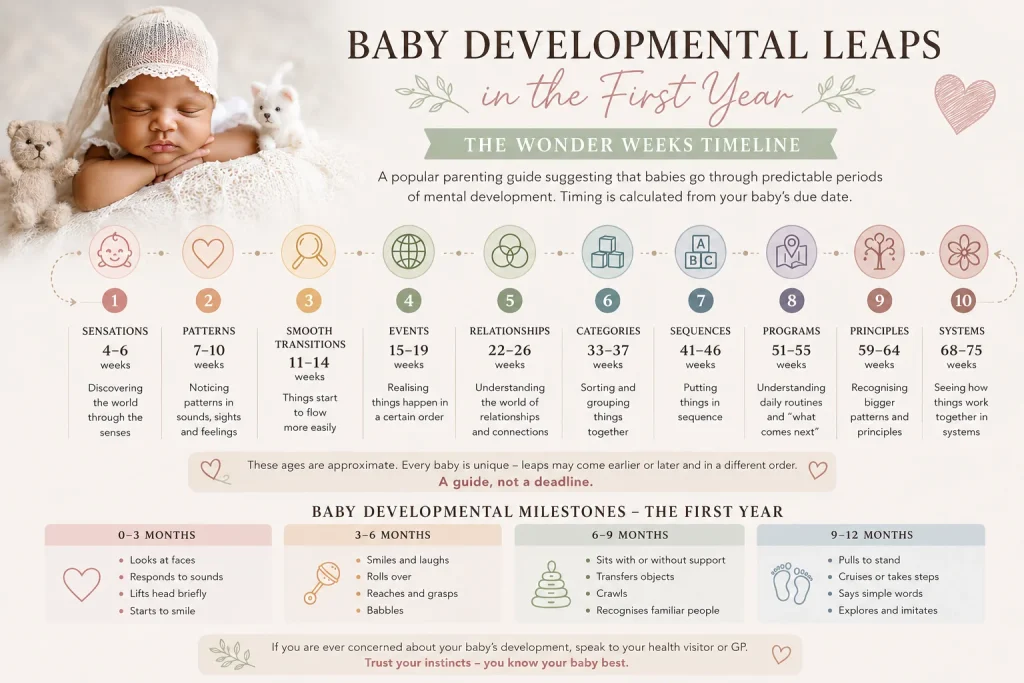
The 10 Baby Developmental Leaps – Why the Weeks Are Only a Guide
The popular Wonder Weeks model describes 10 baby developmental leaps, beginning in the first weeks of life and continuing beyond a baby’s first birthday. Each leap is associated with a new way of experiencing or understanding the world — from sensations and patterns to relationships, sequences and more complex systems.
You will often see these leaps presented as particular weeks, just like in the timeline above. This can make the calendar look surprisingly precise. However, those numbers should never be interpreted as strict deadlines.
A baby does not suddenly enter a new developmental stage because the calendar has reached a particular Tuesday.
Instead, the weeks are intended to represent approximate developmental periods. Some parents feel that their baby’s behaviour fits these periods remarkably well, while others notice very little change or see new abilities emerging at completely different times.
This is one of the most important things to remember when reading about baby developmental leaps: the timeline can be interesting and reassuring, but your baby does not need to follow it exactly.
An Interesting Detail: The Due Date Matters More Than the Birth Date
One of the most interesting parts of the Wonder Weeks approach is something many parents don’t realise at first.
The leap timeline is traditionally calculated using a baby’s estimated due date rather than simply their actual date of birth.
Imagine two babies are born on exactly the same day. One arrived three weeks early, while the other was born a week after their expected due date. Although their birthdays are identical, the Wonder Weeks model would place them at different points on its developmental timeline.
This makes the numbered weeks rather more flexible than they may initially appear.
It also connects with a much broader and well-established principle in child development: when babies are born prematurely, their corrected age can be important when assessing their development.
The NHS explains that for babies born prematurely, developmental age is calculated from the original due date until the age of two.
So, Are Baby Developmental Leaps Scientifically Proven?
This is where it is important to separate an appealing parenting theory from what science can confidently tell us.
There is no question that a baby’s brain and abilities develop enormously during infancy. Babies gradually learn to recognise familiar people, communicate, control their bodies, explore objects, understand their surroundings and interact socially.
What is less certain is the claim that these changes occur in the same predictable sequence of difficult periods at approximately the same weeks for every baby.
Research into highly predictable developmental “leaps” has not produced strong enough evidence for healthcare organisations such as the NHS to use the Wonder Weeks calendar as a developmental assessment tool.
That does not mean that parents are imagining the changes they notice.
A baby may genuinely have periods when sleep changes, new skills emerge or behaviour becomes more demanding. The important distinction is that we cannot confidently look at a particular week on a calendar and use it to explain everything happening with an individual baby.
For that reason, I think the most useful way to approach baby developmental leaps is as an interesting parenting framework rather than a medical rule.
The calendar may help you notice changes and understand that difficult phases can be temporary. It should never be used to decide whether a baby’s development is normal or to explain away behaviour that is causing you concern.
Developmental Leaps and Developmental Milestones Are Not the Same Thing
These two terms are easily confused, but they describe different ideas.
A developmental leap refers to the popular theory that babies experience particular periods of rapid developmental change.
A developmental milestone, on the other hand, is an ability or behaviour that most children are expected to demonstrate by a particular age range.
Milestones can include things such as smiling, responding to sounds, reaching for objects, sitting, moving around, communicating and interacting with familiar people.
Even here, the ages are not deadlines.
Children develop at different rates, which is why healthcare professionals look at the overall pattern of a child’s development rather than expecting every baby to acquire every skill on exactly the same day.
The CDC’s developmental milestone guidance, for example, organises development into age stages while emphasising ongoing developmental monitoring and discussing concerns with a healthcare professional.
My Baby Is Suddenly So Fussy – Could It Be a Developmental Leap?
One of the reasons baby developmental leaps have become so popular with parents is simple: they can offer a possible explanation for those periods when a baby suddenly seems completely different.
Perhaps your baby was sleeping reasonably well and is now waking more frequently. Maybe they want to be carried constantly, become upset when you put them down, feed differently or seem overwhelmed much more easily.
When there is no obvious reason for the change, it can be reassuring to remember that babies are developing incredibly quickly during their first year.
However, these behaviours are not proof that a developmental leap is happening. Sleep, feeding and crying can change for many reasons, and sometimes there is no single explanation at all.
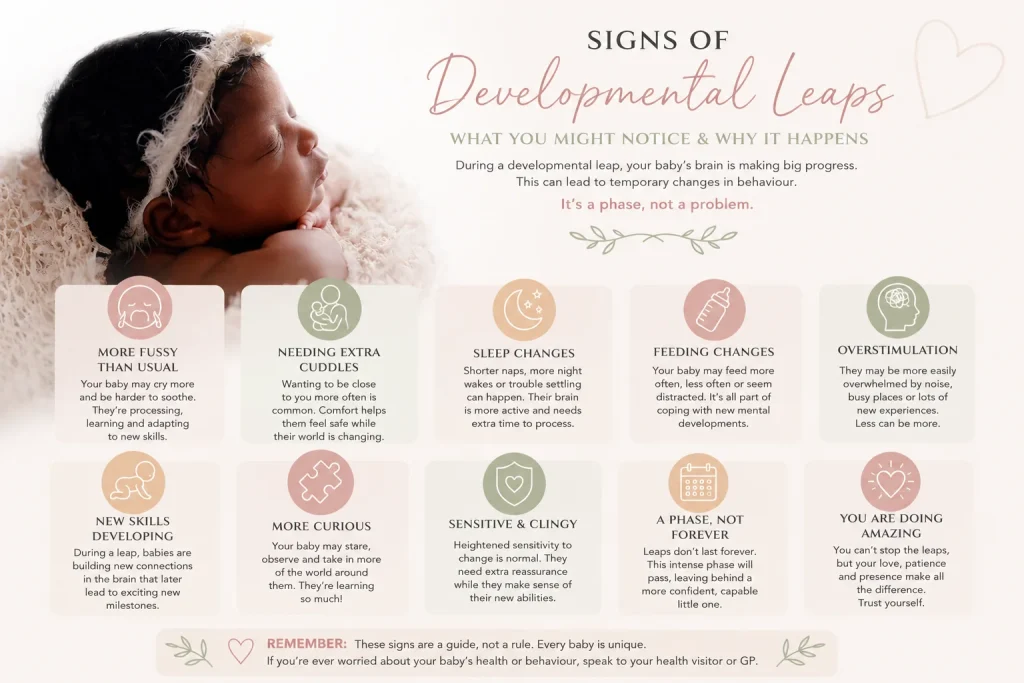
So rather than treating the following signs as a checklist, think of them as changes that some parents may notice during periods of rapid development.
More Crying or Fussiness
A previously content baby may suddenly become harder to settle or cry more frequently.
For parents, this can be one of the most difficult changes because there may be no obvious answer. You have checked the nappy, offered a feed, tried cuddling, changed the temperature and attempted every settling technique you know — yet your baby is still unhappy.
Periods like this can coincide with developmental change, but increased crying should never automatically be labelled as a leap.
Babies cry for many reasons, including hunger, tiredness, discomfort, overstimulation, illness or simply needing closeness.
Wanting More Cuddles and Reassurance
You might also notice that your baby suddenly wants to be much closer to you.
They may settle happily in your arms but protest as soon as you put them down. They might want more cuddles, reassurance or contact than they did only a few days earlier.
This doesn’t mean you are creating a “bad habit”.
Responding warmly to a baby’s needs is part of building a secure relationship. The NHS recommends responding to babies with cuddles, talking, eye contact and comfort as part of their early emotional and social development.
And sometimes, during a particularly unsettled phase, being close to you may simply be exactly what your baby needs.
Changes in Sleep
Sleep is another area where parents often notice sudden changes.
A baby may:
- wake more frequently at night,
- take shorter naps,
- become harder to settle,
- resist a previously predictable bedtime,
- or temporarily need more help falling asleep.
It can be tempting to look at a developmental calendar and immediately conclude, “We’re in a leap.”
Sometimes the timing may appear to fit. But infant sleep changes continually, particularly during the first year, and development is only one of many possible influences.
A developmental leap chart therefore shouldn’t be used as a sleep diagnosis. It is better viewed as one possible piece of a much larger developmental picture.
Feeding May Feel Different Too
Some parents report that their baby wants to feed more frequently during unsettled periods. Others notice distraction during feeds or temporary changes in their usual feeding pattern.
Again, there isn’t one universal baby developmental leap feeding pattern.
Feeding behaviour changes as babies grow, become more alert and increasingly interested in everything happening around them.
If your baby is feeding significantly less than usual, has fewer wet nappies, appears unwell or you are concerned about feeding or weight gain, seek professional advice rather than assuming that a developmental leap is responsible.
Your Baby May Suddenly Notice Everything
Not every developmental change is difficult.
One of the loveliest things about watching a baby grow is seeing their world gradually become bigger.
A light, sound, face or object that barely attracted their attention before may suddenly become fascinating. Your baby might stare intensely at something completely ordinary, repeatedly explore an object or become much more interested in people around them.
With increased awareness can also come overstimulation.
A busy room, unfamiliar people, lots of noise or a long day may sometimes become harder for a baby to process. What worked perfectly last week may suddenly feel like too much.
And then, sometimes almost unexpectedly, you notice something new.
A smile.
A different sound.
A stronger grip.
Rolling.
Reaching.
Sitting.
Recognising someone across the room.
Babbling.
Trying to move towards something they want.
These little changes are much more useful to observe than waiting for a particular number on a developmental calendar.
A Difficult Week Doesn't Always Mean a Developmental Leap
This is probably the most important part of this entire article.
The idea of baby developmental leaps can be reassuring. When you have had several difficult nights and your baby suddenly seems unsettled, knowing that development isn’t always a smooth, predictable journey may help you feel less worried about every temporary change.
But a leap should never become the automatic explanation for a baby who appears unwell.
A developmental calendar cannot tell you whether crying is caused by development, hunger, discomfort or illness.
If something about your baby’s behaviour concerns you, trust that concern.
In the UK, parents can contact their health visitor or GP for advice. NHS guidance also provides information about signs of serious illness in babies and young children and when urgent medical help may be required.
Development Isn't a Race
Perhaps the most reassuring thing to remember is that your baby doesn’t know what week they are supposed to do something.
One baby may sit earlier and crawl later. Another may be incredibly vocal but take more time with physical skills. Some babies seem to acquire several new abilities almost at once, while others develop in smaller, gradual steps.
Developmental milestones help parents and healthcare professionals observe development, but they aren’t a competition between babies.
And the same principle applies to baby developmental leaps.
If your baby doesn’t become unsettled during the week shown on a chart, nothing is wrong. If you don’t suddenly notice a dramatic new skill afterwards, that doesn’t mean your baby has “missed” a leap.
A calendar can be interesting.
Your individual baby is far more important than the calendar.
From Newborn to One Year – So Much Changes in Just 12 Months
Whether or not you follow the baby developmental leaps calendar, one thing is undeniable: the amount of change that happens during a baby’s first year is extraordinary.
Think about the tiny newborn you first brought home.
During those early weeks, so much of their world revolves around sleeping, feeding and being close to the people who care for them. Their movements are small, their expressions often fleeting and their whole body can fit comfortably against your chest.
And then, almost without noticing when it happened, things begin to change.
They start watching your face.
Then comes that first intentional smile.
Their hands begin reaching for things. Their little personality becomes increasingly visible. They discover their feet, toys, sounds and eventually the possibility of moving themselves towards something interesting.
A few months later, the tiny newborn you remember may be sitting independently, laughing at familiar people, crawling across the floor or trying to pull themselves up.
By their first birthday, it can be difficult to believe how much has happened in only twelve months.
And while developmental charts can help us understand some of these changes, they can never capture the little things that make your baby’s first year uniquely theirs.
are.
The Milestones Between the Milestones Matter Too
We naturally remember the big firsts.
The first smile.
The first time they roll.
The first time they sit independently.
The first crawl.
Perhaps the first step.
But there are hundreds of smaller changes happening between those recognised baby developmental milestones.
The way your baby curls their fingers around yours.
The expression they make when they recognise your voice.
The concentration on their face when they discover something new.
The way they gradually change from a sleepy newborn into a curious little person who knows exactly who their favourite people are.
These moments don’t appear neatly on a developmental checklist.
Yet for many parents, they eventually become some of the details they miss the most.
.
Photographing the First Year as It Really Happens
This is one of the reasons I find photographing a baby’s first year so fascinating.
As a photographer, I don’t expect every baby of a particular age to behave in exactly the same way. A four-month-old, a seven-month-old and a ten-month-old can each arrive at the studio with completely different abilities, personalities and confidence levels.
Even two babies of exactly the same age can be wonderfully different.
Rather than trying to force a baby into what they are “supposed” to be doing at a certain stage, I prefer to photograph who they are at that particular moment.
Sometimes that means a beautiful new sitter proudly showing off their balance.
Sometimes it is a baby fascinated by their toes.
Sometimes it is an enormous smile.
And sometimes it is simply the way they look at Mum or Dad.
All of those stages deserve to be remembered.
A Guide, Not a Deadline
Perhaps this is the simplest way to think about baby developmental leaps and milestones.
They can give us a framework for understanding the enormous amount of development happening during infancy. They can help us notice new abilities and sometimes offer reassurance when our baby’s behaviour temporarily changes.
But they cannot predict every baby.
The popular Wonder Weeks timeline should be treated as a parenting guide rather than a medical developmental calendar. Evidence-based milestones provide a more structured way of monitoring development, but even these are designed to identify patterns and potential concerns — not to turn childhood into a race.
Your baby’s development is their own.
Some changes will happen gradually. Others may seem to appear overnight. Some weeks may feel easy, while others may leave you wondering what happened to the routine you thought you had finally figured out.
And that’s why looking back at the first year can feel so extraordinary.
You don’t simply see a collection of milestones.
You see a little person emerging.
When Should I Ask for Advice About My Baby's Development?
If something about your baby’s development or behaviour is worrying you, you don’t need to wait for the next milestone or developmental leap to pass before asking for advice.
In the UK, your health visitor or GP can discuss your baby’s development with you. Routine health and development reviews are also an opportunity to talk about progress and raise concerns. The NHS advises parents to speak to their health visitor or GP if they have concerns about their child’s development.
A developmental leap chart should never replace professional advice.
It can be an interesting way to observe your baby’s changing behaviour.
It shouldn’t be used to explain away something that doesn’t feel right.
Final Thoughts on Baby Developmental Leaps
The first year isn’t a perfectly organised sequence of ten predictable changes.
It is much more interesting than that.
Baby developmental leaps offer one popular way of thinking about periods of rapid change, while developmental milestones give us an evidence-informed framework for following a child’s progress.
Used sensibly, both can encourage us to do something valuable: slow down and notice just how much our babies are learning.
So if your baby suddenly wants an extra cuddle, becomes fascinated by something completely ordinary or surprises you with a skill you weren’t expecting yet, perhaps you don’t always need to rush towards the next milestone.
Sometimes the most wonderful part is simply watching it happen.
Want to remember more than just the big milestones?
My Watch Me Grow sessions document your baby’s changing personality and development throughout their first year, from the tiny newborn stage to their first birthday.